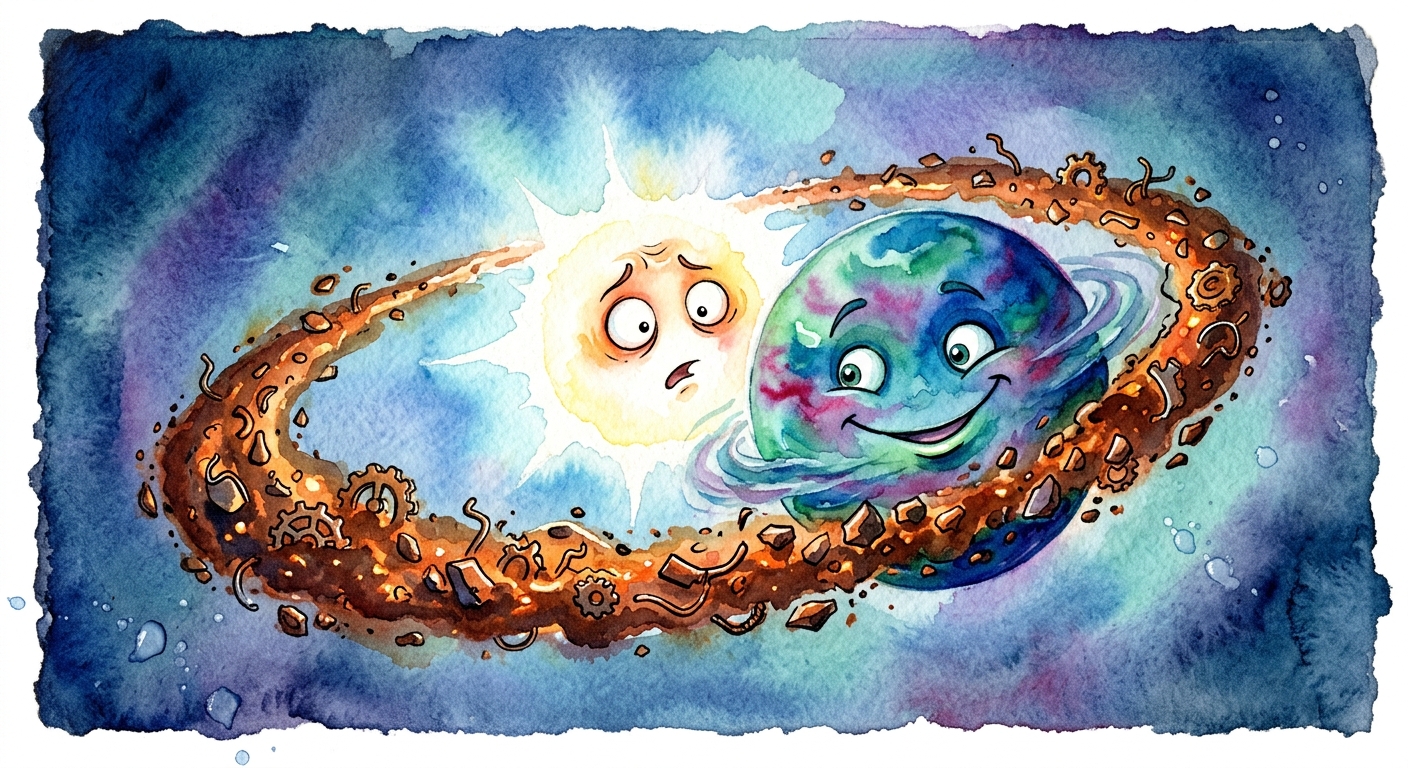
In a discovery that sounds more like mythical folklore than astrophysics, astronomers led by the University of Warwick have spotted a rare second-generation "phoenix planet" rising directly from the ashes of its dead host star. Located roughly 250 light-years away in the constellation Cetus, the candidate celestial body orbits a smoldering white dwarf named HS 0209+0832. Unlike standard planets that form alongside their parent stars, this Jupiter-sized gas giant appears to have coalesced out of the material cast into space during its host star's final death throes.
The groundbreaking clues were uncovered when researchers analyzed archival data from NASA's Hubble Space Telescope and discovered an unprecedented abundance of heavy chemical elements, including copper, zinc, and notably niobium, raining down onto the white dwarf's surface. Because heavy elements sink rapidly within white dwarf atmospheres, their lingering presence suggested an active, nearby source. Subsequent observations from NASA's TESS satellite revealed a subtle, periodic dip in brightness every 4.4 days, pointing to a close-orbiting giant planet whose outer atmosphere is being stripped away by extreme ultraviolet radiation.
Lead researcher Jamie Williams noted that finding a second-generation world around a white dwarf was entirely unexpected, likening the celestial phenomenon to a mythical bird rebirthing itself from its own pyre. Beyond its extraordinary origin story, the discovery provides scientists with a fascinating preview of what could eventually happen in our own solar system when the Sun reaches the end of its stellar lifetime in roughly five billion years.